
A City-Building Superhero: Spotlight on Alice Cabaret
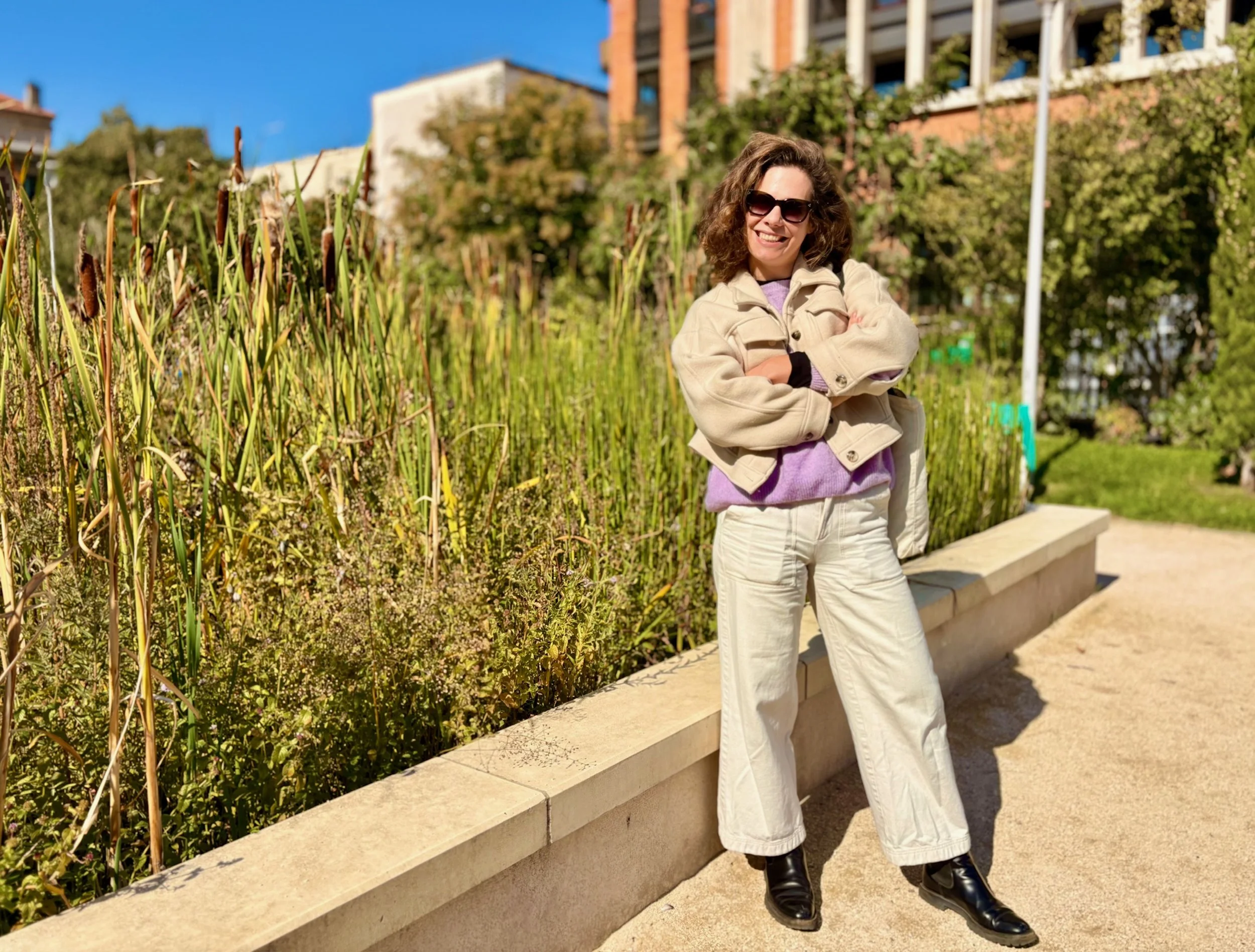
Urban strategist Alice Cabaret pauses on our tour of the 10TH arrondissement of Paris
If every city has its own cast of superheroes, then urban strategist Alice Cabaret is one of the rare ones whose superpower is seeing what others don’t. When I came to her office for our interview, she was in constant motion. Purple sweater, white pants, black boots, hair thrown into a messy ponytail—she carried an air of kinetic energy that made the whole room crackle. She talked rapidly, fingers tapping at her laptop keyboard as she tried to finish the slides she needed for a presentation that same evening. But even while toggling between windows, she was fully present with me, often showing me her slides, telling me stories, bubbling with ideas and the kind of delight that only comes from truly loving what you do.
Cabaret has recently worked at figuring out what work feeds her soul and what work quietly drains it. That self-inquiry has led her to a discovery that now shapes her practice: she is most alive when she’s helping cities bring old buildings back to life.
Champion of Adaptive Reuse
In a world that still too often defaults to the tabula rasa model of planning—wipe it clean, start fresh, and pretend there was nothing worth saving—Alice is a proud dissenter. She believes the future of urbanism lies in adaptive reuse: the art and discipline of transforming what we already have.
“We need to look at the full carbon cycle,” she insists. “We have better technology now. We can adapt and reuse instead of demolishing.” For her, giving love to unloved buildings is a full-time responsibility—one that requires planners, architects, policy-makers, and citizens to see past a tired façade and into the potential beneath the surface.
Where some might see decrepit warehouses, empty industrial facilities, or unloved commercial spaces, Alice sees stories, cultural heritage, emotional attachments, and latent opportunities for transformation. She has a remarkable gift for uncovering, with community members, the deeper meanings they attach to a building. And she knows that when you breathe new life into an existing place, something deeper happens: people begin to believe that transformational change is possible.
“It brings optimism,” she says, her eyes lighting up. “If you can show people a completely transformed space, it becomes a catalyst. They start to look at other places in their neighbourhood and imagine what else could be reclaimed, and given a new life.”
Let Form Follow Feelings
Alice is educated not as a designer but as an urban strategist, which perhaps explains her guiding mantra: Let form follow feelings. Where traditional modernism declared “form follows function,” Alice proposes a paradigm shift—one where emotional experience, cultural connection, and sensory engagement shape our cities just as much as engineering or zoning bylaws.
Her office mascot, a podenco with soulful eyes and boundless charm, often accompanies her on “sensorial walks”—a practice she encourages for clients, students, and community members alike. A sensorial walk is simple: slow down, pay attention, notice the invisible layers of urban life. How does a place smell? Sound? Feel underfoot? What feelings does it evoke? What does it repress?
For Alice, emotional mapping—making our inequalities, our joys, our discomforts more visible—is central to designing for authentic urban experience. If we can understand how people truly connect with spaces, we can create cities that nurture the human spirit.
Loving the Unloved
What sets Alice apart is not just her passion for adaptive reuse, but her empathy. She sees dignity where others might see obsolescence, and potential where a private developer might see only the cost of renovation. Her work reminds us that old buildings are not barriers to progress—they are bridges to identity, continuity, memory, and meaning.
Alice Cabaret is, in every sense, a city-building superhero—one who teaches us to look again, look closer, and look with feeling.
